






Integrated Multi-System Simulation
Engine models connect directly with other systems modeled in GT-SUITE, including thermal, hydraulic, electrical, and controls. This enables full aircraft-level analysis within a single simulation environment.
GT-SUITE models aircraft engine performance across every altitude and flight condition, predicting thrust, fuel efficiency, and emissions before hardware ever exists.
SOLUTION OVERVIEW
Aircraft engine development demands accurate performance prediction across a wide range of operating conditions, from cold start to full mission profile. GT-SUITE provides a modular modeling environment that supports all major engine configurations, including single and dual spool, turbofan, turboprop, turboshaft, APU, and piston engines, as well as non-standard configurations that fall outside conventional categories. The solver handles compressible Navier-Stokes flow with time-accurate transient capability, giving engineers reliable results during both steady-state and dynamic operating events. Built-in compressor and turbine map interpolation and extrapolation tools ensure accurate off-design performance prediction without requiring additional tooling.
Engineers can also develop and validate control logic directly within the simulation environment, using a dedicated controller library to protect critical parameters such as turbine inlet temperature. Models are SiL, HiL, and real-time capable, supporting a continuous workflow from early design through control system validation and testing.
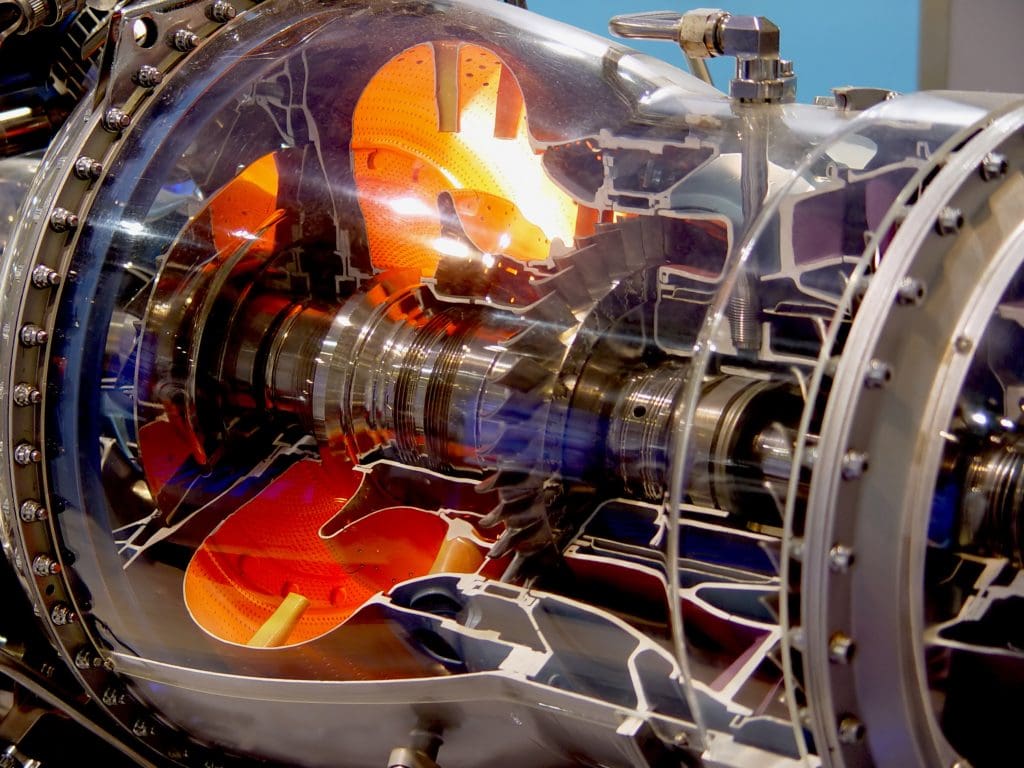
APPLICATION HIGHLIGHTS
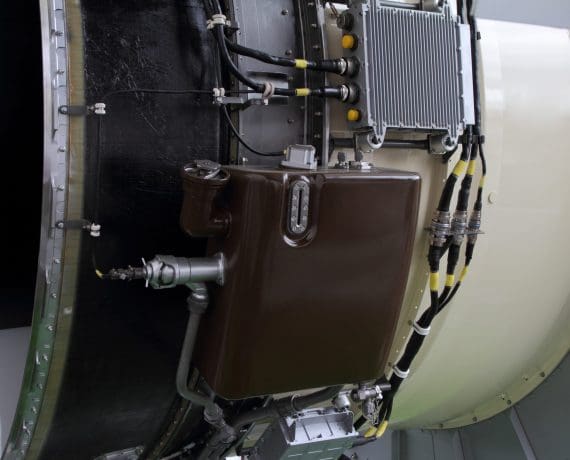
ADVANCED FEATURES
Engine models connect directly with other systems modeled in GT-SUITE, including thermal, hydraulic, electrical, and controls. This enables full aircraft-level analysis within a single simulation environment.
Aircraft vehicle models support complete mission analysis with transient altitude and temperature changes, allowing engineers to evaluate engine performance across realistic flight profiles before hardware is available.
Supports start-up by electric motor with an optional detailed electric circuit model, or by injection of high-pressure air from an APU, covering the full range of real-world start-up scenarios.
Engineers can select between equilibrium or kinetic chemistry approaches for combustion modeling, enabling accurate prediction of combustion performance and emissions across all engine operating conditions.
Dedicated compressor surge modeling allows engineers to identify and mitigate surge risk during design, reducing the likelihood of costly hardware failures during development and testing.
Models support variable geometry intakes and nozzles, including during transient simulations, as well as hydromechanical components such as thrust reversers and variable geometry nozzles in the flow stream.
Common questions about simulating aircraft engine performance, configurations, and system integration in GT-SUITE.
GT-SUITE supports all major aero engine configurations, including single spool, dual spool, turbofan, turboprop, turboshaft, APU, piston engines, ramjets, and pulsejets . The modular modeling approach also accommodates non-standard configurations, so engineers are not limited to predefined architectures. If your engine falls outside a conventional category, the platform can be adapted to match it.
Yes. GT-SUITE models are used to predict thrust, fuel consumption, and emissions across the full range of design altitudes and velocities prior to any physical testing . This allows engineering teams to identify performance issues and refine designs earlier in the development cycle, reducing the cost and risk associated with late-stage hardware changes.
Control logic can be developed and validated directly within the same simulation environment used for engine performance analysis . A dedicated controller library allows engineers to set limits on turbine inlet temperatures and other critical parameters, supporting protection logic development without requiring a separate toolchain.
GT-SUITE engine models are SiL, HiL, and real-time capable, meaning the same model built for design analysis can be deployed into software-in-the-loop, hardware-in-the-loop, and real-time test environments . This continuity across the development workflow eliminates the need to rebuild or re-validate models when moving from simulation to bench testing.

