← Back to All Solutions

Solutions

Scientific AI (Machine Learning)

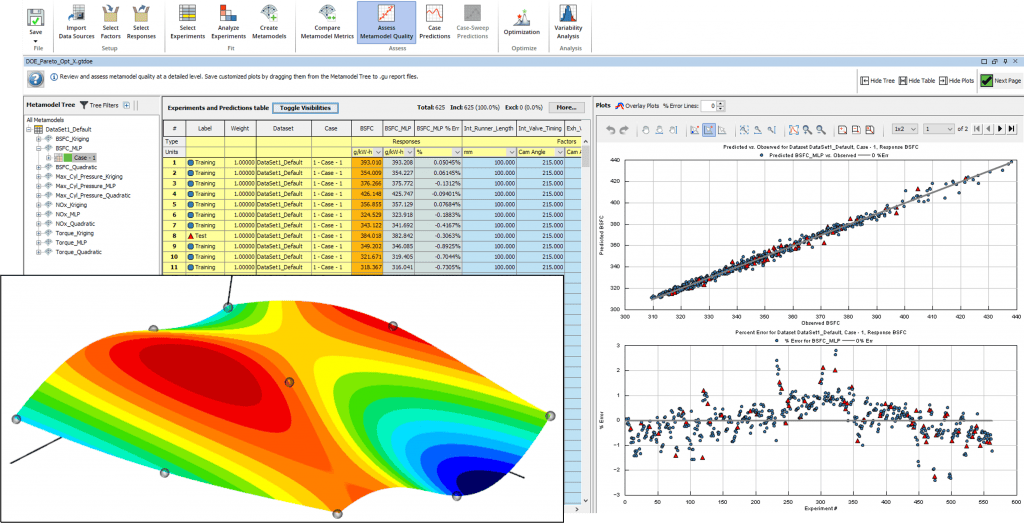
GT-SUITE includes a visual-oriented machine learning platform that enables transforming data – whether it’s generated from simulations or taken from measurements and testing – into fast-executing metamodels.

SOLUTION OVERVIEW

Scientific AI at Gamma Technologies

Scientific AI combines physics-based simulation and machine learning to help engineers solve complex problems faster and with greater confidence. By integrating machine learning directly into the solver, it accelerates simulations, improves predictive accuracy, and uncovers insights from simulation and test data. In GT-SUITE, Scientific AI supports smarter digital twins, real-time decision-making, and rapid design exploration, enabling teams to optimize performance, improve efficiency, and innovate faster. 

How the Machine Learning Assistant Democratizes Scientific AI 

The Machine Learning Assistant makes Scientific AI accessible through an intuitive, no-code workflow. It guides users through data preparation, model training, validation, and deployment, eliminating the need for machine learning expertise. Engineers can quickly build high-fidelity metamodels and surrogate models and integrate them directly into GT-SUITE simulations. By lowering barriers to AI adoption, the Machine Learning Assistant helps domain experts accelerate analysis, optimization, and engineering decision-making within their existing workflows. 

APPLICATION HIGHLIGHTS

Scientific AI within GT-SUITE

  • Build fast and accurate surrogate models

    Build fast and accurate surrogate models

    No machine learning expertise required. MLA guides you through the full fitting process for both steady-state operating maps and transient drive cycles, including dynamic metamodel architectures that learn to mimic time-dependent system behavior. Built-in validation metrics confirm generalization to unseen conditions before you deploy into optimization loops, real-time applications, or system-level integration.

  • Fault and Anomaly Detection

    Fault and Anomaly Detection

    MLA’s classification and anomaly detection capabilities turn your simulation data into intelligent diagnostic models, identifying operating regimes, flagging abnormal system behavior, and detecting edge cases that fall outside expected boundaries. Deploy directly into real-time monitoring pipelines to catch faults early and keep systems operating within safe, validated limits.

  • Design for the extremes, not just the average

    Design for the extremes, not just the average

    Real-world products and systems have inherent operation variability that can be predicted by simulation. The Monte Carlo variability analysis tool in GT-SUITE is beneficial for determining the probability density distribution of a system’s response. This information can be used to design products and systems more robustly by anticipating extreme operating conditions.

  • Uncover design insights

    Uncover design insights

    One way to simplify a design of experiments or optimization study is to identify important and unimportant model input variables. Sensitivity analysis can assist engineers to determine the model inputs that are crucial for system optimization. The GT-SUITE Machine Learning Assistant provides several sensitivity analysis (factor screening) methods to simplify design of experiments and optimization studies.

  • Visually explore the design space

    Visually explore the design space

    Stop re-running simulations every time a design question changes. With MLA’s interactive Response Surface Maps and factor sliders, you sweep across the metamodel inputs in real time. Tune any factor combination and watch predicted responses update instantly across the full multi-dimensional design space, without queuing a single additional GT-SUITE run.

  • Easy deployment and integration

    Easy deployment and integration

    Surrogate models are only valuable when they reach the application. MLA exports your trained metamodels in multiple formats like FMU, ONNX or C code as well as direct integration into GT-SUITE via a MetamodelHarness. Whether embedding into a system-level model, a real-time controller, or an external optimization framework, MLA ensures a seamless handoff from training to production.

Advanced Applications

Accelerating Engineering with ML and Optimization

check mark icon

Sensitivity & variability analysis

The Machine Learning Assistant includes several statistical techniques for identifying the most and least impactful factors on a system’s responses. These tools enable the modeler to simplify their analysis by removing negligible factors and honing their designs by focusing on the most important ones.

check mark icon

Dynamic regression models

Capture transient and inertial effects of dynamic systems with NARX and NeuralODE algorithms. Despite their robust and powerful capabilities, these advanced algorithms are lightweight enough to execute faster than realtime on controllers and other hardware-constrained devices.

check mark icon

Direct Optimization using metamodels

For slower executing simulations where direct optimization is impractical, perform an efficient sampling of the design space and train the resulting dataset to metamodels. The resulting fast-executing metamodels can then be quickly optimized to design your system. Optimization techniques enable the exploration of new design concepts by efficiently balancing multiple objectives, making it easier to innovate while maintaining performance and feasibility.

check mark icon

Time-Series Fault and Anomaly Detection

GT-SUITE is an accurate data generator for simulating faults, and such datasets can be trained to fault detection metamodels, which are capable of distinguishing between normal operation and different fault conditions. Don’t know what specific faults your system will encounter? An anomaly detection metamodel can be trained to normal operating data and th

Connect with an Expert

Looking for guidance on a systems simulation challenge or project? Fill out the form below and our team will reach out to discuss how we can help.