








Transient Outlet Temperature Prediction
GT-SUITE predicts water temperature at the heater outlet throughout the full transient cycle, giving engineers accurate performance data across real-world draw patterns and operating conditions.
Model, analyze, and optimize gas-fired, heat pump, electric, tankless, boiler, and hybrid water heater systems within a single simulation platform.
Solution Overview
Water heater development involves complex thermal interactions that are difficult and costly to evaluate through physical testing alone. GT-SUITE provides a complete simulation environment built on a proven thermal-fluid platform, supporting fast and accurate steady-state and transient analysis across gas-fired, heat pump, tankless, electric, boiler, and hybrid configurations.
Engineers can adjust key design variables directly within the model, including tank geometry, dip tube dimensions, electric element placement, insulation properties, and burner design, to evaluate performance trade-offs without building physical prototypes . The 1D/3D approach runs complete transient simulations in minutes, making it practical to perform virtual testing against standard ratings such as UEF, first hour rating, and recovery efficiency.
GT-SUITE integrates naturally alongside 3D CFD tools, with each approach applied where it delivers the most value. Modeling the full system at multiple fidelity levels allows teams to identify optimal designs through simulation rather than trial-and-error testing, reducing physical test cycles and accelerating development decisions.
Application Highlights
Advanced Features
Accelerate water heater development through virtual testing, design exploration, and system optimization.
GT-SUITE predicts water temperature at the heater outlet throughout the full transient cycle, giving engineers accurate performance data across real-world draw patterns and operating conditions.
The model resolves spatial temperature gradients within the storage tank, capturing the physical dynamics of thermal stratification, mixing, and buoyancy-driven flow that 1D-only approaches cannot represent.
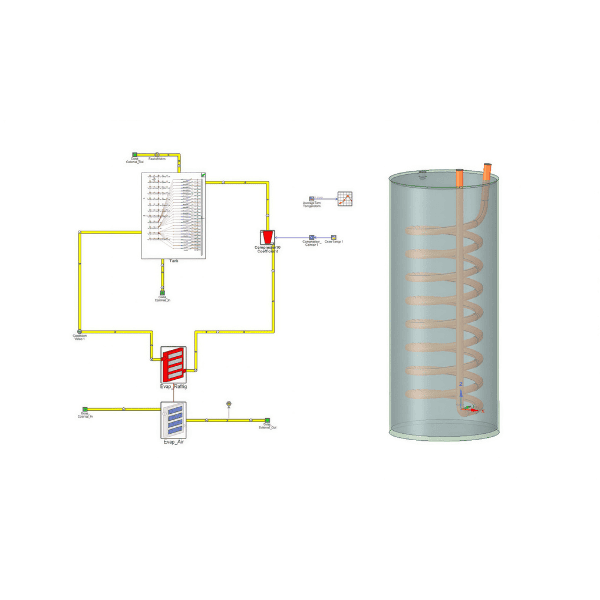
For heat pump water heaters, GT-SUITE models the complete 2-phase refrigerant cycle in transient conditions, resolving pressures, temperatures, and fluid properties throughout the system at every time step.
Engineers can run virtual tests against standard regulatory metrics, including the Uniform Energy Factor, first hour rating, recovery efficiency, TREF, and V40, reducing dependence on physical test lab time.
Electric element placement and dip tube entry height are directly adjustable within the model, letting engineers test sensitivity to component layout without rebuilding the simulation. The model then resolves mixing and buoyancy-driven flow inside the tank, capturing how placement decisions actually affect thermal performance.
The 1D/3D hybrid approach runs complete transient water heater simulations in minutes, making it practical to evaluate a wide design space and iterate on control strategies, heat source configurations, and component geometry within a normal engineering schedule.